
Long-term revenue
Co-location turns megawatt-hours into GPU compute hours, giving producers 10 to 20 years of revenue visibility above spot market prices.

Why CloudGrid
AI growth is now limited by access to power, not by software. CloudGrid Energy flips the data centre model: many renewable sources, each feeding its own on-site AI unit, instead of one giant campus waiting years for a grid connection.
The bottleneck
Inference workloads are exploding while data centre electricity use doubles. Hyperscalers already have more demand than power to serve it.
⅔
of global AI compute demand expected to be inference in 2026, up from one-third in 2023.
×2
possible for data centre electricity consumption between 2022 and 2026, in the IEA's projections.
2026
Microsoft expects Azure to stay capacity-constrained until at least mid-2026, with demand ahead of the capacity it has.
Our model
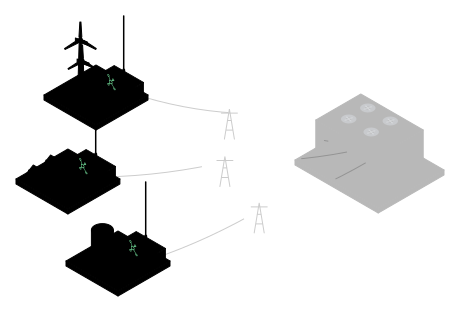
A solar, wind or biomass plant, or an EV charging hub, with green competitively priced power, controlled land and an existing grid connection.
A modular HPC container with GPUs, CPUs, storage, waterless cooling and ultra-high-speed connectivity, installed on site.
Low-carbon GPU capacity for European SMEs, startups and enterprises, interconnected through Poligrid, the distributed network that links every Policloud unit.
Capital efficiency
A container on an existing grid connection avoids the buildings, land and electrical works of a hyperscale campus. GPUs and servers are excluded from the comparison.
For energy producers
Renewable producers face volatile spot prices and expiring support schemes. An on-site compute offtake turns their electricity into a premium, long-term revenue stream.
Co-location turns megawatt-hours into GPU compute hours, giving producers 10 to 20 years of revenue visibility above spot market prices.
Our first unit runs on a wind farm reaching the end of its feed-in tariff contract, consuming its electricity locally.
Units plug into existing grid connections, avoiding the multi-year queues that block new data centres.
“In a more constrained environment for renewables, we needed a solution to increase the economic value of our electricity. Policloud converts our kWh into CPU/GPU compute hours, creating a new high value-added revenue stream.”
Sovereignty
Until now, high-performance AI infrastructure was reserved for the largest global digital players. Our network gives European SMEs, startups and entrepreneurs affordable inference capacity that stays under EU jurisdiction.
Our commitment
Every site we select must offer three things. Above all, local green electrons must always exceed 50% of what the GPUs consume.
Renewable producers, EV hubs, landowners and AI teams: join Europe’s clean compute grid.